KDP Composition Notebook Journal Covers: A Practical Guide to Smarter Low Content Publishing
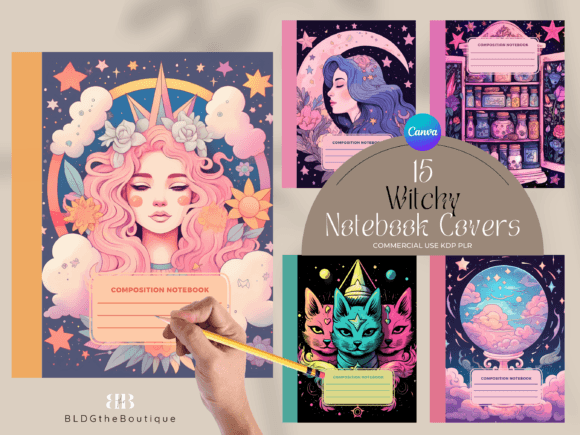
For anyone building a low content publishing business on Amazon KDP, the visual front of your product often does the heavy lifting. A well-designed cover doesn't just catch a scroller's attention in search results—it sets expectations, communicates a mood, and helps a notebook feel like it belongs to the person holding it. This is where a focused set of KDP Composition Notebook Journal Covers becomes more than a design asset. It becomes a strategic lever for your publishing workflow, especially when you're targeting a specific aesthetic niche. The witchy composition notebook cover bundle we're exploring gives you fifteen editable Canva templates, pre-sized for a standard 110-page 7.5"x9.25" interior. Each one is built to save time, maintain visual consistency, and let you run lean product experiments without staring at a blank canvas every time.
But turning a collection of covers into a reliable income stream on KDP requires more than a download button. You need to think about category positioning, what your buyer really wants, and how to structure your publishing cadence so you're not just adding noise to a crowded marketplace. This article walks you through what these covers are, why they matter strategically, and how to use them with intention—so you get more than just an upload out of your investment.
Understanding What You're Actually Getting
Before we talk strategy, let's ground ourselves in the tool itself. This bundle includes 15 witchy composition notebook covers delivered as 300 dpi JPG files and as Canva templates. The JPGs are rendered at 12.3" x 16.4", giving you enough resolution for professional printing. The Canva files are formatted for a complete front-and-back cover spread measuring 15.498" x 9.5"—that's the full wrap including spine, designed specifically to match a 110-page interior. Within Canva, you can edit the label color, the spine color, and the font choices. Resizing is also possible if you need a different trim size, though you'll want to adjust the spine width calculation accordingly for Amazon KDP's requirements.
What's notable here isn't the quantity of fifteen designs; it's the modularity built into the template system. Every cover is structured so you can produce multiple notebooks from a single template simply by changing the subject line on the label or the accent color. For example, one cosmic crescent design might become a Book of Shadows notebook, a Moon Phase Journal, and a Witch's Herbal Grimoire just by altering the text. This approach dramatically reduces the per-title design effort while keeping your catalog visually cohesive. The commercial POD license lets you use these on books you sell, which is a critical detail for anyone serious about building an income stream rather than dabbling in one-off gifts.
Why Niche-Specific Covers Outperform Generic Ones
Low content notebook categories are saturated with designs that lean heavily on broad appeal—flowers, mandalas, cute animals. That's not a bad thing, but it means you're competing on price and keyword luck. When you commit to a clearly defined sub-niche like "witchy," "occult stationery," or "modern metaphysical," you're entering a conversation that already has an engaged audience. Shoppers looking for a witchy composition notebook aren't simply hunting for any lined pages; they often want tools that reflect their spiritual or aesthetic identity. Buying such a notebook is an extension of personal practice, and that emotional connection drives purchase decisions more reliably than a few dollars lower on the price tag.
This bundle of KDP Composition Notebook Journal Covers helps you exploit that niche depth. With celestial motifs, botanical line art, dark moon phases, and vintage occult-inspired lettering, each cover signals a specific sub-taste. As a seller, you can lean into long-tail keywords that generic covers can't touch. Instead of "notebook journal," you're targeting "witch journal spell book" or "herbalist notebook grimoire." The search volume per term is lower, but conversion rates are often higher because the product matches buyer intent much more precisely. This reduces reliance on heavy advertising and lets organic discovery work in your favor over time.
Integrating These Covers into a Sustainable Publishing Plan
Having great covers is one thing; deploying them in a way that builds a catalog rather than a random collection is another. A strategic approach starts by answering a few foundational questions before you hit "Export" in Canva.
Identify Your Sub-Niche Angles First
Don't try to make all fifteen covers appeal to the exact same person. Instead, segment them. Maybe five of these designs tilt toward the astrological/star chart aesthetic—those become journals for Lunar Phase Tracking, Zodiac Reflections, or Cosmic Gratitude. Another five might feature herbal and botanical elements; those transform into Green Witch Garden Logs, Herbal Remedy Journals, or Foraging Notebooks for kitchen witches. The remaining five could have a darker, more atmospheric look suitable for shadow work journals, dream diaries, or tarot record-keeping. This segmentation prevents keyword overlap within your own catalog and helps you build authority in several distinct micro-niches simultaneously.
Respect the Spine and Back Cover as Marketing Real Estate
On Amazon, the back cover rarely gets seen before purchase, but it influences the customer's unboxing experience—and that matters for reviews and brand memory if you build a series. These Canva templates include a fully designed back cover area. Use it wisely. Consider adding a subtle pattern continuation from the front, a brief phrase that speaks to the journal's purpose ("Document your solitary path," "Track the turning wheel of the year"), or a simple frame that leaves the back clean but designed. Avoid clutter; you want the notebook to feel intentional.
The spine label is editable too. For a witchy line, that spine text is a huge opportunity. Shoppers often see notebooks stacked or spine-out in customer photos, Instagram, or Pinterest. A clean, legible spine that reads "Shadow Work Journal" or "Herbal Grimoire" keeps your product visible even after purchase, reinforcing its identity. When you edit the spine in Canva, make sure the font color contrasts enough with the dark backgrounds common in this aesthetic. Some designs might have metallic gold or white text; you can easily swap this inside the template to ensure readability.
Operational Workflow: From Template to KDP Dashboard
One of the biggest friction points for low content publishers is handling cover specifications for varying page counts and trim sizes. The good news here is that the templates are pre-sized for a 7.5"x9.25" notebook with 110 pages. That's a common composition book size and usually yields a spine width around 0.304" with white paper, depending on paper weight. If you stay within that page count, you can export a PDF directly from Canva and upload it as your KDP cover without additional calculation. If you decide to resize—for example, to fit an 8.5"x11" format—you'll need to recalculate the spine in KDP's cover template tool and adjust the Canva design dimensions accordingly. The label and spine are editable, so resizing won't break the design if you work carefully, but always generate a KDP cover template for your exact interior first.
Plan your uploads in small themed batches rather than all at once. Publish three journals from one sub-niche, then observe a week of sales and organic impressions. Note which titles get page reads or units. That data can inform which designs to extend next. Perhaps the celestial group outperforms the herbal group; you then prioritize creating three more cosmic covers using the existing templates with new label variations. Because you're not commissioning each cover from scratch, this kind of lean iteration becomes financially low-risk.
Brand Cohesion Without a Formal Brand
Many low content sellers operate under a generic "Author's Name" imprint, but you can build subtle brand recognition even with separate pen names or a single generic account. Use the editable font and label color in these templates to create design consistency across all witchy notebooks. If you settle on a specific font pairing—say, a serif title font and a clean sans-serif for the subtitle—apply that consistently to every cover you modify. The same goes for the spine label color. If most of your covers use a muted gold accent, keep that across editions so your product line photographs well as a group. This increases the chance of multi-purchase from a single customer browsing your catalog, which boosts your BSR and gives Amazon's algorithm stronger co-purchase signals.
The Risk of Using Ready-Made Covers Without Strategy
There is a genuine danger with bundles like this: the "plug and publish" illusion. Simply downloading the files, writing basic text on the cover, and uploading without thought leads to the kind of notebook found on page ten of search results—no clear audience, no mood consistency, no compelling reason to buy. Also, remember that these designs are not unique. Other sellers will use the same graphics. Your advantage has to come from how you position the book, not just the art itself. If you rely purely on the cover's visual appeal and generic keywords, you become interchangeable with anyone else who bought the bundle. The antidote is editorial framing. Use your title and subtitle to specify usage: "The Solitary Witch's Dream Journal: A Bedside Notebook for Recording Visions and Symbols" feels purposeful, not generic. Pair the cover with an interior that matches the theme—maybe it's just simple ruled lines, but you could also upload a PDF interior with a subtle header illustration or thematic date line. This adds perceived value and sets your offering apart.
When to Use These Covers Versus Alternatives
This bundle works best when you're entering a niche with strong visual expectations—witchy and metaphysical communities value aesthetics deeply. In contrast, if you're targeting corporate meeting notebooks or basic student journals, this pack won't serve you. Know your lane. These covers are also ideal for seasonal pushes: October and Samhain season see a spike in occult-related searches. Having a pre-made cover ready to adapt lets you launch a timely product in under an hour, when speed-to-market matters. Conversely, if your research tells you that a specific space lacks witchy composition books, you might want a completely custom cover to dominate that slot. Use these templates as a baseline for validation, then consider reinvesting profits into custom art once a title proves itself.
Practical Steps for Getting the Most Out of the Canva Templates
- Audit the covers immediately upon download. Open each one and note what elements you can realistically change without breaking the layout. Identify which parts are truly editable (label background, text, spine color) and which might require more skill to alter. This prevents mid-project frustration.
- Prepare a text file with 50+ niche-specific title ideas. Seed it with terms like "Grimoire," "Lunar Log," "Hedge Witch Journal," "Tarot Record," "Esbat Planner." Having a bank of authentic language speeds up the creative process and keeps your titles fresh.
- Use Canva's bulk export feature if you create multiple variations. Once you've set up a template with your preferred color palette and font choices, duplicate the design for each new title, make small text edits, then export all versions as PDF Print files. Check each one for alignment issues caused by text changes before uploading to KDP.
- Create a simple spreadsheet to track which cover design links to which ASINs. Over time, you'll want to see which visual themes perform best. Without tracking, you're operating blind. Note the dominant colors, imagery type (celestial, botanical, minimalist), and first-month sales. Let data guide which covers you evolve next.
Long-Term Value: Building a Catalog That Compounds
The real payoff from investing in a set of KDP Composition Notebook Journal Covers isn't a quick-hit sale. It's the asset base you accumulate. Each well-chosen title that uses these covers becomes a small digital product that can earn royalties with no further work. If you publish ten thoughtful witchy journals this month, a year from now each one could still be generating occasional sales, especially if you've targeted niches with steady interest rather than fleeting trends. The editable nature of the Canva templates also means you can periodically refresh cover details—swap a font that's starting to feel dated, or adjust colors to align with emerging palette preferences—without rebuilding the entire design. This extends the shelf life of your catalog far beyond what a static JPG alone would allow.
Moreover, the skills you build while modifying these templates transfer directly. Manipulating label placement, understanding how spine width changes with page count, selecting complementary typefaces—these are fundamental to low content publishing. Treat these covers not as a turnkey solution but as a structured playground to sharpen your design instincts. Over time, you'll develop a sixth sense for what a high-converting KDP composition notebook cover needs, and you'll bring that insight into every subsequent publishing decision, whether you're using another bundle or commissioning original artwork.
In the end, these fifteen witchy covers are a springboard. They give you visual assets that are market-ready but demand your strategic input to become viable products. By pairing them with clear audience awareness, disciplined keyword research, and a consistent publishing rhythm, you turn editable templates into income-generating tools that work for you months and years down the line. Ignore the shortcut mindset and embrace the editor's mindset—and you'll find that these KDP Composition Notebook Journal Covers do far more than fill a blank upload screen. They help you build a publishing practice that's both profitable and personally satisfying.