Master the Art of Futoshiki: Your Ultimate Guide to 2,400 Printable Logic Puzzles
If you love Sudoku but crave something with an extra layer of challenge, Futoshiki might just become your new favorite puzzle. Sometimes called "Unequal" or "Hutoshiki," this elegant Japanese logic game takes the familiar grid-based number placement you know and adds a clever twist: inequality symbols that force you to think more deeply about the relationships between cells. And now, with a comprehensive collection of 2,400 printable Futoshiki puzzles available as digital downloads, you can dive into this rewarding pastime at your own pace, on your own terms, and on actual paper.
What Is Futoshiki? Understanding the "Not Equal" Puzzle
The word Futoshiki translates from Japanese to mean "not equal" or "inequality" — and that simple idea forms the beating heart of the entire puzzle. At its core, Futoshiki is a logic puzzle played on a square grid, most commonly ranging from 4×4 for beginners up to 9×9 for seasoned experts. The goal is deceptively straightforward: fill each row and column with the numbers 1 through N (where N is the grid size), ensuring that no number repeats in any row or column. So far, it sounds exactly like Sudoku. But here's where the inequality symbols come into play.
Scattered throughout the grid, you will see greater-than (>) and less-than (<) signs placed between adjacent cells. These symbols dictate a strict relationship: the number in one cell must be greater than or less than the number in the neighboring cell, as indicated. These constraints radically change how you approach solving the puzzle. Suddenly, it is not just about what numbers are possible in a given cell based on row and column exclusions — it is also about how those numbers must relate to their immediate neighbors. The result is a puzzle that feels both familiar and refreshingly original, demanding a different kind of logical reasoning than Sudoku alone.
How to Play Futoshiki: A Step-by-Step Foundation
For anyone new to the game, the mechanics are wonderfully easy to grasp, yet mastering them can take a lifetime. Here is the basic framework:
- The Grid: You start with a square grid. Common sizes include 4×4, 5×5, 6×6, 7×7, 8×8, and 9×9. The larger the grid, the more challenging the puzzle tends to be.
- The Numbers: In a grid of size N, you must use the numbers 1 through N exactly once in each row and exactly once in each column. For a 6×6 grid, for instance, each row and column must contain the digits 1, 2, 3, 4, 5, and 6.
- The Clues: Some cells are pre-filled to give you a starting point. More importantly, inequality symbols ( > and < ) appear between certain cells, establishing a required relationship. If you see A > B, then the number in cell A must be greater than the number in cell B.
- The Logic: Using the combination of given numbers and inequality constraints, you deduce the only possible arrangement that satisfies all conditions simultaneously.
What makes Futoshiki so deeply satisfying is that you rarely need to guess. Every placement follows from careful deduction. If a 6×6 grid has a chain of inequalities like A > B > C > D, you can immediately infer that A cannot be 1, 2, or 3 (since it must be larger than at least three other numbers), and D cannot be 4, 5, or 6. This kind of relational reasoning is the essence of the puzzle and why it sharpens your logical thinking in a way few other games can.
Why Puzzles Like Futoshiki Matter in Modern Life
In an age dominated by screens, notifications, and constant digital noise, the simple act of solving a paper-based logic puzzle has taken on new significance. Futoshiki, like other pencil-and-paper puzzles, offers a form of active relaxation — an activity that engages your brain without overstimulating it. Studies and anecdotal evidence alike suggest that regular engagement with logic puzzles can help maintain cognitive sharpness, improve pattern recognition, and strengthen problem-solving skills that transfer to everyday life and professional work.
Moreover, the structured nature of Futoshiki provides a rare sense of closure. Each puzzle has one unique solution, and reaching it gives you a small but meaningful sense of accomplishment. For people juggling complex jobs, family responsibilities, or creative pursuits, that moment of tidy resolution can be surprisingly restorative. Educators also increasingly recognize the value of inequality-based logic games in teaching mathematical thinking to students, as they make abstract concepts like greater-than and less-than relationships tangible and engaging.
The 2,400 Printable Futoshiki Puzzles Collection: What You Get
For those ready to embrace this puzzle in a serious way — or for entrepreneurs looking to offer high-quality puzzle content to their own customers — the 2,400 Futoshiki Puzzles Printable collection stands out as an exceptional resource. This is not a physical product shipped to your door; it is a digital download package that gives you immediate access to a vast library of puzzles, all designed with clarity, progression, and usability in mind.
The offering consists of 4 printable PDF files, carefully organized to support every stage of your Futoshiki journey:
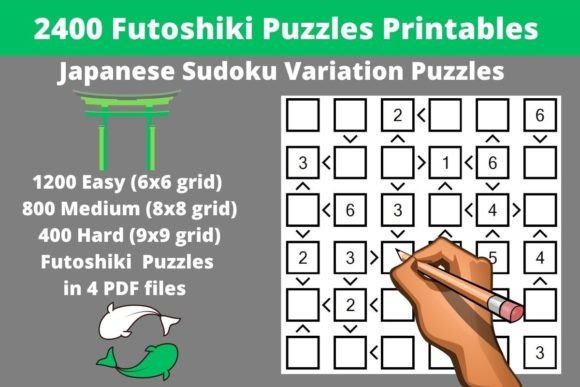
- Futoshiki Easy — 6×6 Grid: 1,200 puzzles with their complete solutions. These serve as the perfect entry point for beginners or a warm-up for experienced solvers. The 6×6 grid size balances accessibility with genuine logical challenge, ensuring you build confidence and skill without feeling overwhelmed.
- Futoshiki Medium — 8×8 Grid: 800 puzzles with solutions. Once you have mastered the 6×6 format, moving to 8×8 deepens the complexity significantly. More cells mean more relationships to track and more opportunities for advanced deduction techniques to shine.
- Futoshiki Hard — 9×9 Grid: 400 puzzles with solutions. This is the expert tier, demanding full concentration and sophisticated logical chaining. The 9×9 grid mirrors the classic Sudoku size but with the added dimension of inequality constraints, creating a truly formidable brain workout.
- How to Play File: A dedicated guide that explains the rules clearly, making the collection accessible even to complete newcomers. This thoughtful inclusion means you do not need to search elsewhere for instructions — everything is self-contained.
One of the smartest design choices in this product is the formatting: each page contains one puzzle or one solution. This layout gives you total flexibility. You can print a single puzzle per sheet for a spacious, easy-to-read solving experience, or you can use your printer settings to fit multiple pages onto one sheet of paper, effectively creating multi-puzzle pages that save paper and ink. Whether you prefer working on full-size grids or compact booklets, the control is entirely yours.
Designed for Real-World Printing and Versatility
The practical considerations of this collection have clearly been thought through. The PDF files are formatted to print on standard 8.5 × 11 inch paper (US Letter) or A4 paper — the two most common paper sizes worldwide. This means no matter where you are or what printer you own, you can produce clean, usable puzzle sheets without resizing headaches or awkward margins.
Because this is a digital product, there is no waiting for shipping, no physical clutter, and no limit on how many times you can use it. Once you download the files, you are free to print the puzzles as many times as you like. This makes the collection incredibly cost-effective over time. Run out of puzzles? Simply print more. Prefer to work in pencil and erase? Print fresh copies whenever you need them. Want to compile a custom puzzle book for a long trip? Select your favorite pages and print them in any order you choose.
Personal Use and Commercial Opportunities: KDP and Beyond
What truly sets this puzzle collection apart from many other printable logic game products is the commercial use license. The terms explicitly allow you to use these templates not only for personal enjoyment but also for commercial purposes. This opens up a world of possibilities for creative entrepreneurs, particularly those involved with Print on Demand (POD) platforms such as Amazon KDP (Kindle Direct Publishing), Etsy, or similar marketplaces.
Imagine creating your own branded puzzle books, activity journals for adults or seniors, logic puzzle subscription boxes, or educational worksheet packs — all powered by this extensive library of 2,400 puzzles. The solve-once-print-many nature of the content means you can build multiple products from the same source files. For KDP publishers, the clear layout of one puzzle or solution per page aligns perfectly with the standard interior formatting expectations for puzzle books. The inclusion of solutions for every puzzle also means your end customers will have a complete, self-contained experience, which is a significant value-add for any published puzzle book.
Of course, the puzzles remain equally valuable for purely personal use: family game nights, classroom activities, homeschooling enrichment, senior center programs, or simply a daily brain-training ritual. The dual-use flexibility means you get maximum value regardless of how you choose to engage with the material.
Tips for Getting the Most Out of Your Printable Futoshiki Puzzles
To truly enjoy and benefit from this extensive collection, consider a few practical strategies:
- Start where you are comfortable. Even if you are an experienced Sudoku solver, Futoshiki's inequality constraints add a new dimension. Begin with the 6×6 easy puzzles to internalize how the greater-than and less-than symbols interact with standard row and column rules, then progress naturally toward the 8×8 and 9×9 challenges.
- Use a pencil — and embrace erasing. Unlike digital puzzle apps, paper solving allows for tentative notations and the satisfying physicality of marking your deductions. Keep an eraser handy and do not hesitate to jot down candidate numbers in the corners of cells.
- Pay attention to inequality chains. One of the most powerful techniques in Futoshiki involves tracing chains of inequalities across the grid. A cell at the high end of multiple > symbols is seriously constrained and often reveals its value through elimination.
- Create a routine. Solving one or two puzzles daily — perhaps with morning coffee or as an evening wind-down — builds consistency and steadily sharpens your logical intuition. With 2,400 puzzles available, you have enough material to sustain a daily habit for over six years.
- Experiment with printing formats. Some solvers prefer large, single-puzzle pages that give room to think. Others like printing four puzzles per page for a more compact, portable challenge. Test different layouts to discover what suits your solving style best.
Why This Collection Is a Smart Investment for Puzzle Lovers
In a market flooded with puzzle apps that demand subscriptions, bombard you with ads, and strain your eyes with screen glare, a printable PDF collection offers something refreshingly permanent and distraction-free. You pay once and gain lifetime access to a carefully curated library that grows with your skill level. No accounts to manage, no notifications to dismiss, no batteries to charge — just you, a pencil, and 2,400 opportunities to sharpen your mind.
The structured difficulty progression from 6×6 through 8×8 to 9×9 grids mirrors the natural learning curve of Futoshiki solving, ensuring that beginners never feel lost while experts always find an adequate challenge. The inclusion of the How to Play file also makes this an excellent giftable resource — you can print a starter set of puzzles along with the instructions and introduce someone new to the joys of inequality-based logic games.
Whether you are a lifelong puzzle enthusiast seeking your next obsession, a teacher hunting for engaging classroom materials, or an entrepreneur building a puzzle-based product line, this 2,400 Futoshiki Puzzles Printable collection delivers exceptional depth, flexibility, and lasting value. Download it, print your first sheet, and discover why Futoshiki — the gentle art of "not equal" — has quietly become one of the most beloved logic puzzles in the world.