Take Control of Your Rental Cash Flow with a Simple Rent Payment Ledger
Every month, money moves between tenants and landlords. A receipt might get lost in an email thread, a due date slips by unnoticed, or a disagreement arises about whether the rent was actually paid on time. Without a single source of truth, that monthly exchange can quickly become a source of unnecessary friction. That’s exactly where a Rent Payment Ledger steps in—a minimal, reusable record that tracks each payment, each balance, and each transaction without relying on spreadsheets you never update or apps that charge a monthly fee. Think of it as a quiet, physical audit trail that lives in your rental binder or property file.
At first glance, a payment log might seem like another form to fill out. But the moment you finish a phone call with a tenant who “swears they paid last month” or try to reconstruct six months of partial payments during tax season, that simple page earns its keep. A well-designed Rent Payment Tracker doesn’t just document numbers; it gives both sides clarity and a shared reference point. Whether you’re a first-time landlord renting out a condo, a long-term tenant who wants to avoid disputes, or a property manager juggling multiple units, this tool turns a chaotic paper trail into a legible history of every payment.
Who Actually Benefits from a Rental Payment Log?
The obvious answer is the property owner, but the usefulness extends far beyond that. A Tenant Payment Log is just as valuable for someone renting a home as it is for the person collecting the check. Imagine a tenant who pays by cash or money order—there’s no automatic bank statement trail. Handwriting each payment into a ledger right at the kitchen table, and having the landlord initial it, creates a receipt that’s just as valid as a printed one. For anyone applying for a future rental, a neat payment history can serve as unofficial rental references, showing a pattern of on-time payments that a credit report might not reflect.
Property managers handling several doors often keep a central Landlord Ledger for each address. When an owner asks for a mid-year summary, flipping through a month-by-month tracker is dramatically faster than digging through bank feeds. Even for informal arrangements—renting a room to a friend, subletting during a summer internship, or managing a short-term vacation rental—the discipline of writing things down prevents those awkward “I thought you said utilities were included” conversations. In shared housing, roommates can use a shared Rental Payment Log pinned in the hallway to track who paid what toward the total rent, keeping group finances transparent without a complicated app.
Real Scenarios Where a Payment Tracker Changes the Game
Consider a landlord who owns a duplex and lives an hour away. Tenants drop off checks at different times, occasionally paying a week late due to payroll schedules. Without a centralized record, the landlord might forget who still owes a late fee or whether a partial payment was applied to last month or this month. Using a dedicated Property Payment Tracker sheet for each unit—kept in a binder with the lease—makes it possible to see at a glance that Unit A paid $950 on the 4th with a $25 late fee noted, while Unit B’s balance carried forward. When tax time comes, that same sheet becomes the raw data for reporting rental income and expenses.
Now flip the perspective. A young professional renting an apartment decides to go back to school and needs to prove a responsible payment history to a new property management company that won’t call individual landlords. By maintaining a personal Rental Receipt Form or ledger with each month’s date, amount, and confirmation number, she can hand over a documented timeline. The minimalist design of a printable ledger means she can pull out a clean copy every year, store the filled pages, and never worry about corrupted files or forgotten app passwords.
In a completely different setting, an artist renting a small studio space pays rent directly to the building owner via bank transfer. The owner is casual; they don’t send formal receipts. At the end of the fiscal year, the artist needs to categorize studio rent as a business expense. A Rental Finance Organizer in the form of a simple ledger—filled in right after each transfer—provides a backup record with dates and amounts, making the accountant’s job easier and supporting the deduction if ever questioned. It’s not about overcomplicating a small business; it’s about removing guesswork.
Moving Beyond the Checkmark: What to Look for in a Functional Tracker
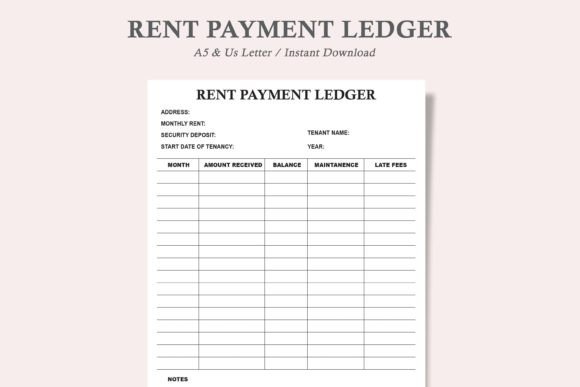
Not all ledgers are created equal, and the reason to choose a printable Rental Finance Tool over a generic notebook is structure. A purpose-built page typically includes columns for the due date, date received, amount paid, method of payment, outstanding balance, and a short notes section. Having those fields pre-printed means you’re far less likely to skip a crucial detail when you’re in a hurry. A strong layout balances white space with clear boundaries—enough room to write the tenant’s name and property address at the top, but not so cluttered that it becomes visually noisy.
The “ink-friendly” aspect may seem minor until you print the same sheet twenty times. A thoughtfully designed Property Income Log uses clean lines and minimal solid black areas, which not only saves toner but also keeps the page looking crisp and professional. Since it’s a digital download, you can store the files on your computer or cloud drive and print a new blank sheet whenever you need one—no waiting for shipping, no bulk purchasing pads you’ll never finish. The flexibility to choose between US Letter and A5 sizes means you can slip the smaller version into a pocket ledger or keep full-sized sheets in a three-ring binder.
How Different Working Styles Adapt the Same Ledger
Some landlords treat the Rent Ledger as a strict accounting record, filling it out immediately upon receiving a payment notification. Others use it more as a calendar, noting expected due dates at the beginning of the year and checking them off as payments clear. Neither approach is wrong. A property owner who travels frequently might print a fresh sheet for each quarter and keep it in a travel folder, updating by hand while away from a computer. A tenant with irregular freelance income might use the ledger to notify their landlord in writing when a payment will be slightly delayed, documenting the agreement right in the notes column for future reference.
An unexpected but common use case pops up in family rental situations. Parents helping a college-age child with off-campus housing often want a straightforward way to see that rent is being paid. A co-signed lease adds financial responsibility; the family can keep a Rental Income Tracker on the fridge, updated monthly, turning a potential source of worry into a visible habit. It’s low-tech, high-clarity. No one needs to grant login access to a banking app or share sensitive financial data beyond what’s necessary.
What to Keep in Mind Before You Start Using a Printable Ledger
A few practical points can make the difference between a pile of forgotten PDFs and a system you actually rely on. First, decide on a storage strategy. Digital downloads are wonderful, but if you never print them, they don’t serve their purpose. Pick a day each month—maybe the first Saturday—to update your Rental Payment Tracker for every unit. The habit is more important than the tool itself. Second, if you’re a landlord accepting online payments, manually recording them in a physical ledger creates a backup that isn’t dependent on any platform’s uptime or data retention policy. That redundancy matters.
Consistency in notation is also worth thinking about early on. Will you always write the tenant’s name in the same format? Will you note the payment method for every entry, or only for cash? Small choices made upfront prevent confusion months later. For property managers dealing with security deposits and prorated rents, a dedicated Rental Financial Planner page can track those one-off items separately, keeping the monthly payment log clean and focused on the recurring rent cycle.
Finally, consider that a printed ledger carries a certain gravity a spreadsheet cell doesn’t. When a tenant sees you pull out their file and write down the amount in ink, it reinforces the seriousness of the transaction. It’s a subtle but real psychological signal that payments are recorded and remembered. In an increasingly automated world, that quiet accountability can improve communication far more than a generic automated reminder.
Sustaining an Organized Rental Operation Over Time
The real payoff of using a Rental Finance Organizer like this accrues slowly. After a year, you have a discreet stack of pages that tell the complete financial story of each property. Someone looking to sell a rental portfolio can present potential buyers with organized payment histories that validate the income stream. A tenant moving out can request a copy of their ledger as proof of timely payments for their next landlord. Even for personal reflection, flipping through a dated log reveals patterns: months where payments consistently lagged, seasonal vacancies, or times when tenants consistently paid early—insights that can shape how you structure future leases.
That’s the beauty of a tool that doesn’t demand a subscription or software update. The Rent Payment Ledger does one thing and does it well. It doesn’t analyze data or predict cash flow. It simply provides a consistent, tangible home for the numbers that keep your rental world turning. In a business model where clarity and trust are the bedrock, that’s not a small thing. It’s the foundation.