Ocean V2 Coloring Pages for KDP Publishing Projects
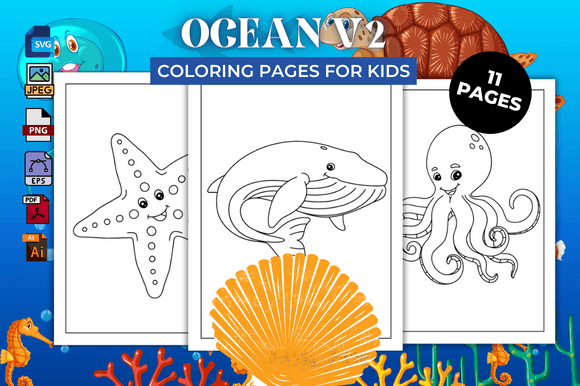
Creating a coloring book that children actually reach for takes more than tossing together simple outlines. The Ocean V2 Coloring Pages - KDP collection gives publishers and independent creators a ready-made set of underwater illustrations designed specifically for the print-on-demand ecosystem. Eleven distinct pages, each scaled to 8.5 by 11 inches with no bleed, arrive in multiple file formats so you can drop them straight into your next Amazon KDP interior and move on to the parts of your business that need your attention most.
What sets this particular collection apart is the thoughtful balance between detail and approachability. A young learner staring at a coloring page needs enough visual interest to stay engaged but not so much complexity that they feel overwhelmed before picking up a crayon. The ocean-themed artwork here leans into recognizable sea creatures and scenes—think gentle waves, friendly marine life, and playful underwater compositions—while keeping line weights consistent and shapes clear enough for small hands to navigate. It is the kind of art that feels lively on the page without crossing into chaotic territory.
A Closer Look at the Visual Personality
Coloring pages live or die by their line art. In the Ocean V2 Coloring Pages - KDP set, the illustration style sits comfortably between whimsical and realistic. Fish have expressive eyes without becoming cartoon caricatures. Coral formations suggest texture without demanding precision coloring from a five-year-old. Shells and starfish appear in arrangements that feel natural rather than forced into rigid symmetry. This organic composition style matters because children respond to imagery that leaves room for imagination. When a page feels too "finished" in its line art, a child has less creative license to make it their own.
The overall personality reads as calm but curious. These are not loud, aggressive illustrations fighting for attention. Instead, they invite a slower, more focused kind of play—exactly what parents and educators want from a coloring activity. The ocean theme itself carries universal appeal. Kids who have never seen the sea still recognize turtles, fish, and shells as approachable subjects. That familiarity reduces the barrier between picking up the book and actually coloring inside it.
Practical Applications Across Publishing and Creative Work
Most buyers coming to this product are thinking about KDP interiors, and rightly so. The files are pre-tested for Amazon's print requirements, which removes a layer of technical guesswork that trips up many first-time publishers. But the usefulness of these illustrations extends further than a single coloring book listing.
Consider activity books that blend coloring pages with puzzles, mazes, or simple word searches. The ocean theme pairs naturally with educational content about marine biology, environmental awareness, or summer vacation themes. A blogger creating printable resources for parents could bundle select pages into a free download to grow an email list. Teachers and homeschoolers can print individual sheets for classroom use without worrying about resolution issues, since the collection includes both vector and raster formats.
From a brand identity standpoint, consistent visual assets matter. If you are building a series of themed coloring books under a recognizable imprint, the Ocean V2 Coloring Pages provide a cohesive foundation. Each of the eleven pages shares a unified aesthetic, so the finished book feels intentional rather than cobbled together from mismatched sources. This kind of visual consistency is what separates hobby projects from products that customers associate with quality.
What the File Format Variety Actually Means for Your Workflow
The inclusion of AI, EPS, SVG, PDF, JPG, and PNG files in one package is not just a bullet point—it is a genuine time-saver for anyone who works across different software environments. Here is how each format earns its place in a real workflow:
- AI and EPS files give you full vector editing capability. If you need to adjust line thickness, remove an element, or combine artwork from different sets, you can do so in Adobe Illustrator or Affinity Designer without degrading quality.
- SVG files open in a wider range of programs, including free tools like Inkscape. They also integrate smoothly into web-based design apps, making them useful for creating digital products or previews.
- PDF is your print-ready format. Drop it directly into KDP's uploader and move on.
- JPG and PNG files handle quick previews, social media promotion, and mockup creation. The PNGs with transparent backgrounds are especially handy for layering onto book cover designs or marketing graphics.
Having all of these ready on day one means you do not spend an afternoon converting files or troubleshooting export settings. For entrepreneurs running multiple KDP projects simultaneously, that kind of efficiency compounds quickly.
How These Pages Support a High-Content Business Model
High-content publishing on KDP rewards volume and consistency, but quality still determines whether a book earns reviews or gets returned. The Ocean V2 Coloring Pages - KDP set addresses the quality side by providing professionally composed illustrations that do not look like they were auto-traced from stock photography. The line art is clean, the compositions are balanced, and the no-bleed specification means you avoid the common headache of trimming issues during printing.
Publishers who understand the brand identity aspect of their catalog will appreciate that these pages can anchor a series. Ocean-themed coloring books sell year-round, with seasonal spikes around summer and gift-giving holidays. By starting with a solid base of eleven pages and potentially combining them with other themed sets, you create a product that feels substantial without the labor of commissioning custom artwork from scratch.
The educational angle should not be overlooked either. Parents browsing Amazon often search for activity books that combine entertainment with learning. An ocean coloring book can naturally incorporate vocabulary words, fun facts about sea creatures, or prompts for creative storytelling. The artwork becomes a vehicle for a richer product experience, and that added value translates into better reviews and stronger rankings.
Readability and Page Layout Considerations
When children color, they need clear boundaries. The line work in this collection maintains a consistent visual hierarchy—major shapes are defined by bolder outlines while interior details use lighter strokes. This approach helps young colorists understand where to focus without explicit instruction. From a design assets perspective, the pages are formatted to work as single-sided prints, which is standard practice for coloring books to prevent bleed-through. If you are assembling a KDP interior, you can confidently place each illustration on its own page without worrying about ghosting issues that lead to negative customer feedback.
Evaluating Whether This Set Fits Your Project
Not every coloring page collection suits every project, and honest evaluation saves time and money. Ask yourself a few practical questions before adding these to your design toolkit:
- Does your target age range match the complexity level of the artwork? These pages work best for children roughly four to eight years old—old enough to stay within lines but young enough to find the subjects engaging.
- Are you building a single product or a series? If a series is the goal, the cohesive style across these eleven pages makes it easier to maintain visual consistency across multiple volumes.
- Do you need to modify the artwork significantly? The vector formats give you flexibility, but if you require entirely different subject matter, you may need additional sets to round out your content.
- Is the 8.5 by 11-inch trim size appropriate for your market? This is the most common format for KDP coloring books, so it aligns well with customer expectations.
Testing how the pages look in a printed proof is always advisable. What appears crisp on screen can behave differently on paper depending on line weight and ink density. Ordering a physical proof through KDP before publishing gives you confidence that the final product matches your standards.
Marketing and Promotion Angles Worth Exploring
The artwork itself can serve double duty in your marketing efforts. Use the PNG files to create eye-catching social media graphics that show partially colored pages alongside the black-and-white original. This side-by-side format performs well on platforms like Pinterest and Instagram, where parents actively search for activity ideas. A short video showing a time-lapse of someone coloring one of the pages can generate engagement and drive curiosity about the full book.
For publishers running Amazon Ads, the visual nature of coloring books gives you an advantage. Custom ad creatives that highlight specific illustrations from the Ocean V2 Coloring Pages set can differentiate your product in a crowded marketplace. Generic ad images blend into the background; showing an actual page from your book gives potential buyers a concrete reason to click.
The commercial licensing built into this product means you are not restricted to a single use. Reuse the artwork across multiple products, bundle it with complementary themes, or incorporate individual illustrations into larger activity book compilations. This flexibility supports the kind of iterative publishing strategy that successful KDP entrepreneurs rely on.
Why Thoughtfully Designed Coloring Interiors Matter
The children's activity book market is saturated with low-effort offerings. Customers have grown savvy about spotting generic, repetitive content. When a coloring book feels assembled rather than designed, it signals a lack of care that extends to the entire buying experience. Investing in quality design assets like the Ocean V2 Coloring Pages communicates professionalism before a single review is written. The artwork itself becomes part of your brand identity, associating your publishing name with a standard of quality that customers remember when they shop for their next purchase.
For the independent publisher working without a dedicated design team, curated collections bridge the gap between doing everything yourself and outsourcing to expensive freelancers. You retain creative control over your product lineup while benefiting from professionally crafted artwork that meets print-ready specifications. In a business where margins depend on efficient production and consistent quality, that combination is genuinely valuable.